Research-led industrial design for a safer, more desirable helmet
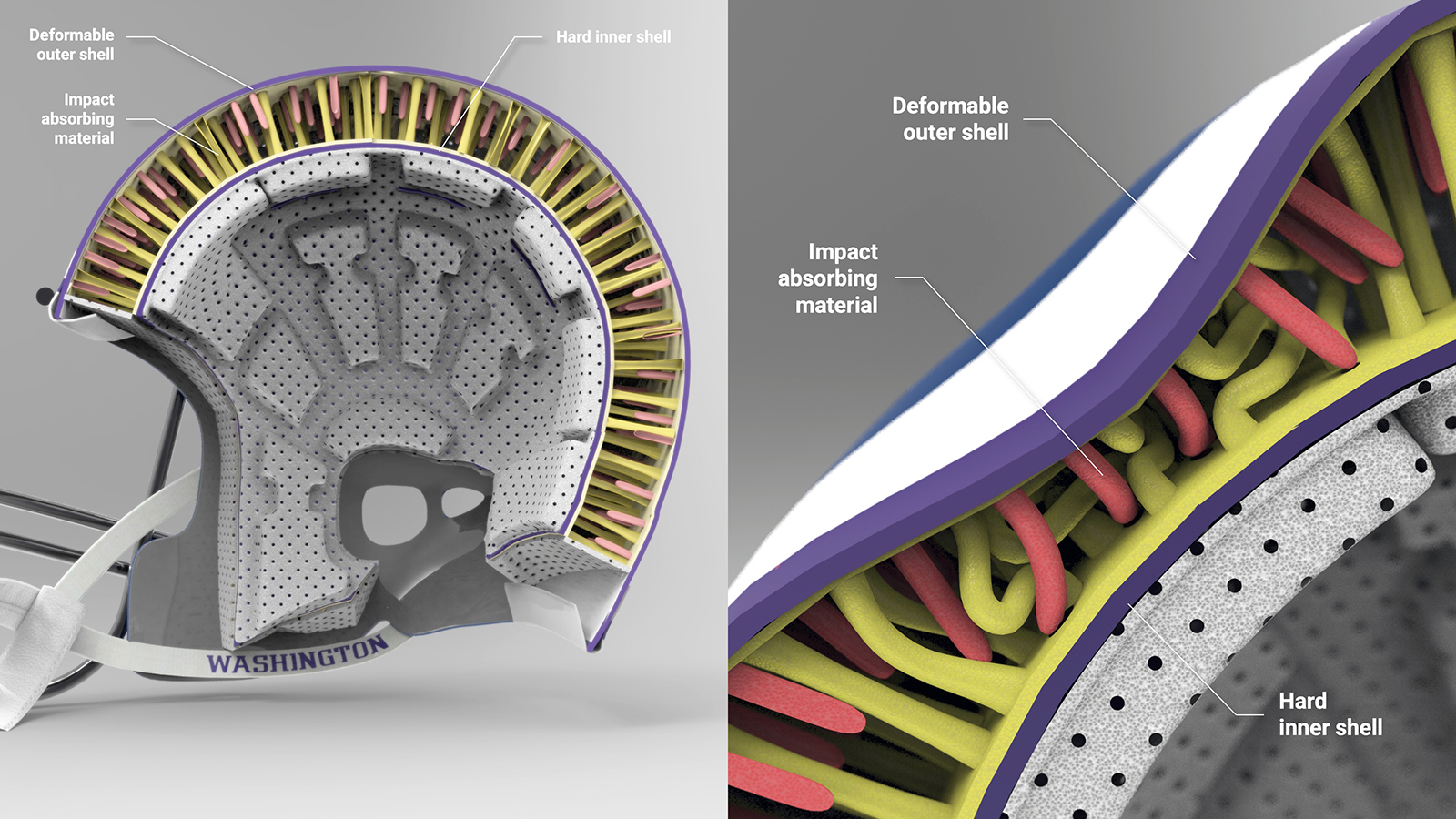
Despite decades of advances in materials science, football helmets had barely evolved since the era of Jim Brown and Johnny Unitas. Concussions, TBI, and CTE were sidelining players at every level and threatening the long-term viability of the sport itself. VICIS, a tech startup spun out of the University of Washington, had engineered a genuine breakthrough: a deformable outer shell with elastic crumple zones that slow impact acceleration before it reaches the brain, borrowed from automotive safety principles.
But superior engineering alone doesn’t get a helmet onto an NFL player’s head. VICIS recognized early that they needed to understand what players, coaches, equipment managers, and medical staff actually wanted — and then use that understanding to design something as desirable as it was protective. They brought in Artefact to lead the research and industrial design work.
Before a single interview, I designed a comprehensive research protocol tailored to each of the four stakeholder groups: players, equipment managers, medical staff, and coaches. Each group had a fundamentally different relationship with the helmet — e.g., what a free safety cares about is categorically different from what an equipment manager or a team physician cares about — and the protocol had to reflect that.
I designed and printed custom field guides for each audience type. Each guide covered the full arc of relevant territory: helmet selection criteria, functional and practical considerations, emotional connections and drivers, technology attitudes, and structured concept feedback using the new VICIS engineering approach. The guides were built as printed, tabbed documents, robust enough to survive field conditions and flexible enough to support improvised conversations.
Research field guides — designed and printed for each of four audience types
Critically, the guides were also designed as capacity-building tools for the VICIS team. We brought client team members into sessions as observers, and the field guides gave them a framework for understanding what they were seeing — how to recognize an insight, how to code a response, how to distinguish a preference from a need. Research as a skill transfer, not just a service delivery.
Alongside protocol design, my industrial design lead project partner conducted a competitive market analysis across the major helmet manufacturers — Riddell, Schutt, Xenith, Rawlings — and led deep technical immersion sessions with the VICIS engineering team to understand the constraints and opportunities in the new shell design before we went into the field.
Competitive context: immersion in the existing helmet ecosystem before fieldwork
I led fieldwork across multiple sites, conducting structured interviews and contextual inquiry with 10–15 participants across all four stakeholder groups. Sessions took place where the work actually happened — in locker rooms, athletic training facilities, equipment rooms, and on sidelines — not in conference rooms. Context matters in research about physical objects: how a helmet feels in your hands when you’re already in pads is not the same as how it feels across a table.
Player sessions combined structured discussion with hands-on concept evaluation; participants handled and tried on existing helmets and gave feedback on images and videos of early VICIS prototypes, talking through what they noticed, what worked, what concerned them.
Player interview sessions
Equipment manager sessions focused on selection logic, durability considerations, fit adjustment mechanics, and the practical realities of managing a full team inventory across a season. Medical staff and coaches provided a different kind of intelligence, less about personal preference and more about what they observed in players, what drove selection decisions at the institutional level, and what would need to be true for a new helmet to earn clinical endorsement or coaching confidence.
SME group session with medical staff
NFL equipment managers: one of the most critical stakeholders outside of the player
After fieldwork, I led synthesis: organizing, coding, and interpreting findings across all four audience segments to identify what was consistent, what diverged by audience, and what was genuinely surprising. The goal wasn’t a list of things people said. It was a structured understanding of what they needed, weighted by who they were and what role they played in the helmet decision.
Synthesis: development of a five-dimensional needs framework for players and non-players
The core output of synthesis was a helmet needs framework spanning five dimensions: Safety, Comfort, Performance, Style, and Functionality/Reliability/Usability. Critically, the framework distinguished between what players prioritized versus what non-player stakeholders required — two different decision-making logics that any successful product had to satisfy simultaneously.
Mapping helmet features and functional elements directly to the needs framework
From the framework, I developed nine strategic design recommendations that were specific, actionable, and grounded in observed behavior. They covered fit feel and break-in period, facemask geometry and peripheral vision, shell proportions relative to existing helmets, weight targets by position, color and finish options within league regulations, and accessory and customization systems. These weren’t preferences. They were requirements, ranked by importance and attributed to specific audience segments.
The research and design work informed the ZERO1’s final industrial design, strategy, and even marketing — resulting in a helmet that looked genuinely different from anything on the market while remaining familiar enough for players to trust. For example, the importance of field of view became a key differentiator and selling point, and helmet customization and position-specific models would eventually follow this first product in the VICIS portfolio. When Virginia Tech tested 33 helmets for impact protection in 2017, the ZERO1 finished first, ahead of Riddell, Schutt, and Xenith models, which together account for roughly 90% of helmet sales.
Performance, safety, style, and more
VICIS secured over $20M in funding post-launch. The ZERO1 was adopted at the professional and collegiate levels, won a top IDEA award from the Industrial Designers Society of America, was named a Fast Company Innovation by Design finalist, and received a Design Value Award from the Design Management Institute. The CEO noted directly that when current and former NFL and NCAA players reviewed the helmet designs, they were consistently impressed by the look and the feel.
Design studio: the exploration wall during concept development
Virginia Tech STAR safety ranking, tested against 33 helmets including Riddell and Schutt, which together hold ~90% of market share.
Funding secured after launch, supported in part by the appearance model and research narrative used in investor presentations.
Top IDSA International Design Excellence Award. Also: Fast Company Innovation by Design finalist, Design Value Award from DMI.
Strategic design recommendations from synthesis, grounded in specific observed behaviors across all four audience segments.