Helping patients navigate the most consequential decision of their lives
After completing treatment for stage 0–III breast cancer, patients face an annual surveillance question their doctors often couldn’t answer for them: standard mammography, or add breast MRI? MRI may detect recurrence earlier — but it also brings false alarms, unnecessary biopsies, cost, and anxiety. There is no universally right answer. The right choice depends on each patient’s individual risk profile and, critically, on what tradeoffs they’re willing to accept.
Three million breast cancer survivors face this decision every year with almost no guidance. They arrived at it already exhausted — post-treatment, managing fear of recurrence, often overwhelmed by medical information they’d been absorbing for months or years. Yet the clinical system had no structured way to help them think it through. Group Health Research Institute (GHRI) partnered with Artefact to build one.
GHRI’s SIMBA study (2013–2016) analyzed 36,000 breast cancer exams — the largest effectiveness analysis of mammography and breast MRI at that time. The data existed. The challenge was making it meaningful at the individual level, for a patient sitting at home, scared, trying to figure out what to ask her oncologist.
Research engaged patients, caregivers, and clinical staff to understand how the decision was actually being made — and where it was breaking down. My role focused on evaluative UX research across iterative design cycles: testing how well patients could parse personalized risk data, whether the values-clarification prompts actually surfaced what mattered to them, and whether the visualizations were helping or inadvertently introducing bias. Cognitive psychology and behavioral economics consultants shaped how options were framed and displayed; plain language experts ensured the content was accessible across education levels.
This information has prompted me to talk to my oncologist about my breast density and if MRI might be warranted. — Breast cancer patient, Artefact interview
Iterative testing drove structural decisions — sequencing values reflection before presenting clinical options, calibrating how numerical risk data was paired with pictographs, and identifying which plain-language framings reduced rather than amplified anxiety. Each round of evaluation tightened the gap between what we intended the tool to do and what patients actually experienced when they used it.
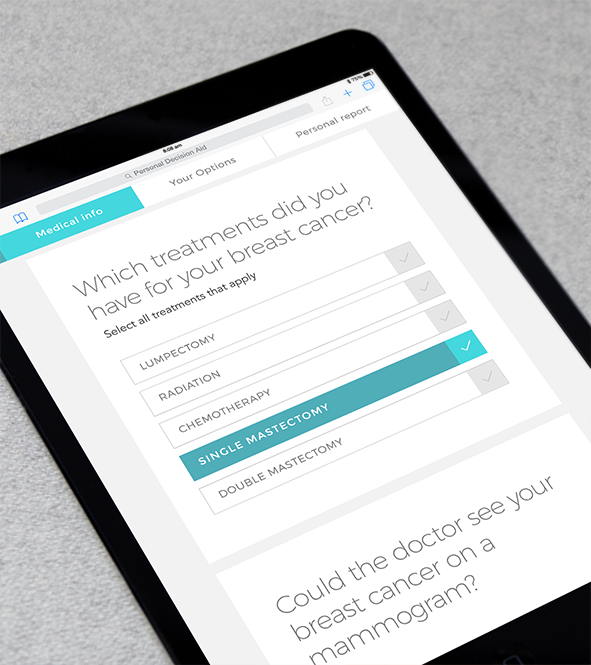
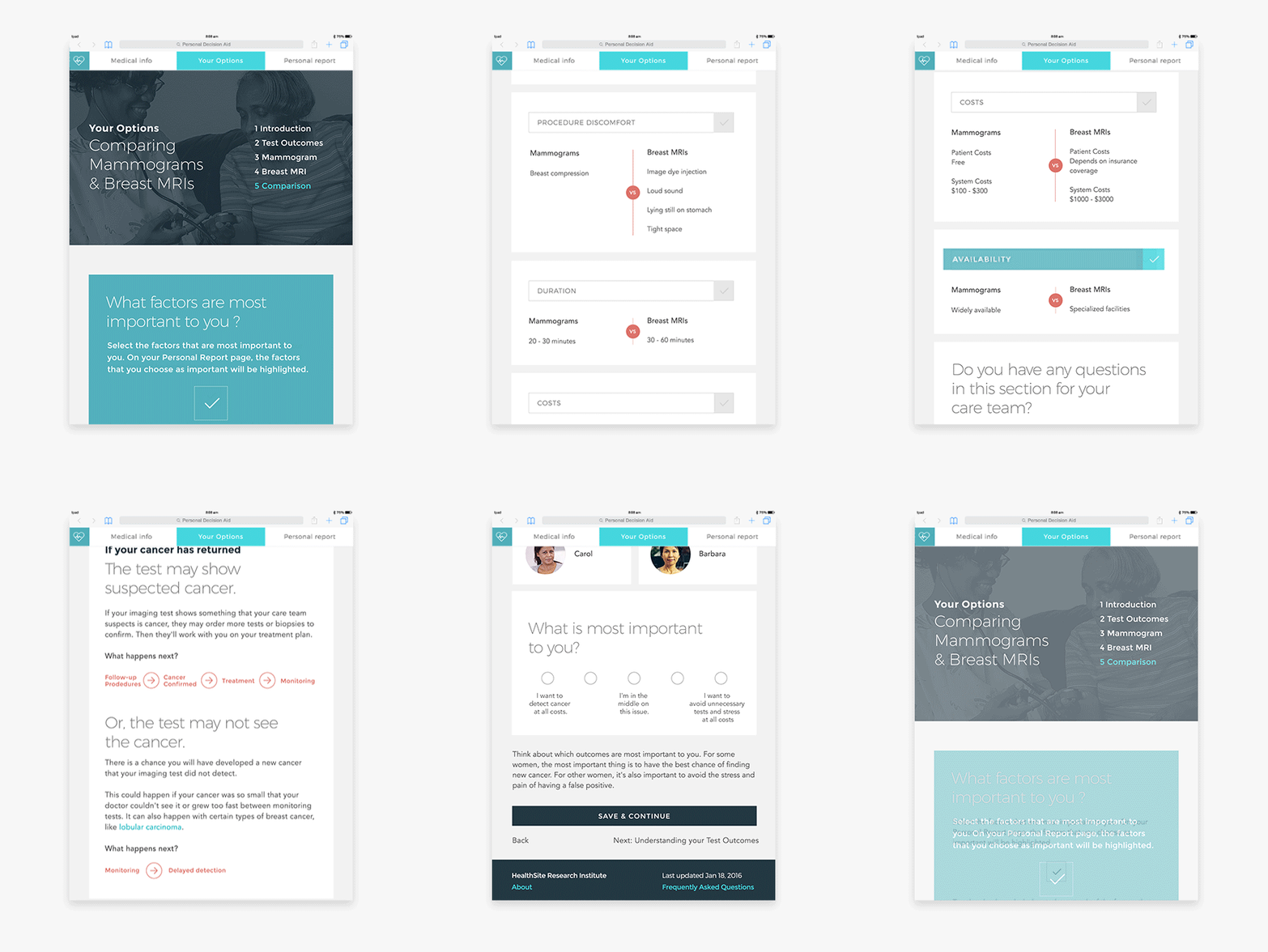
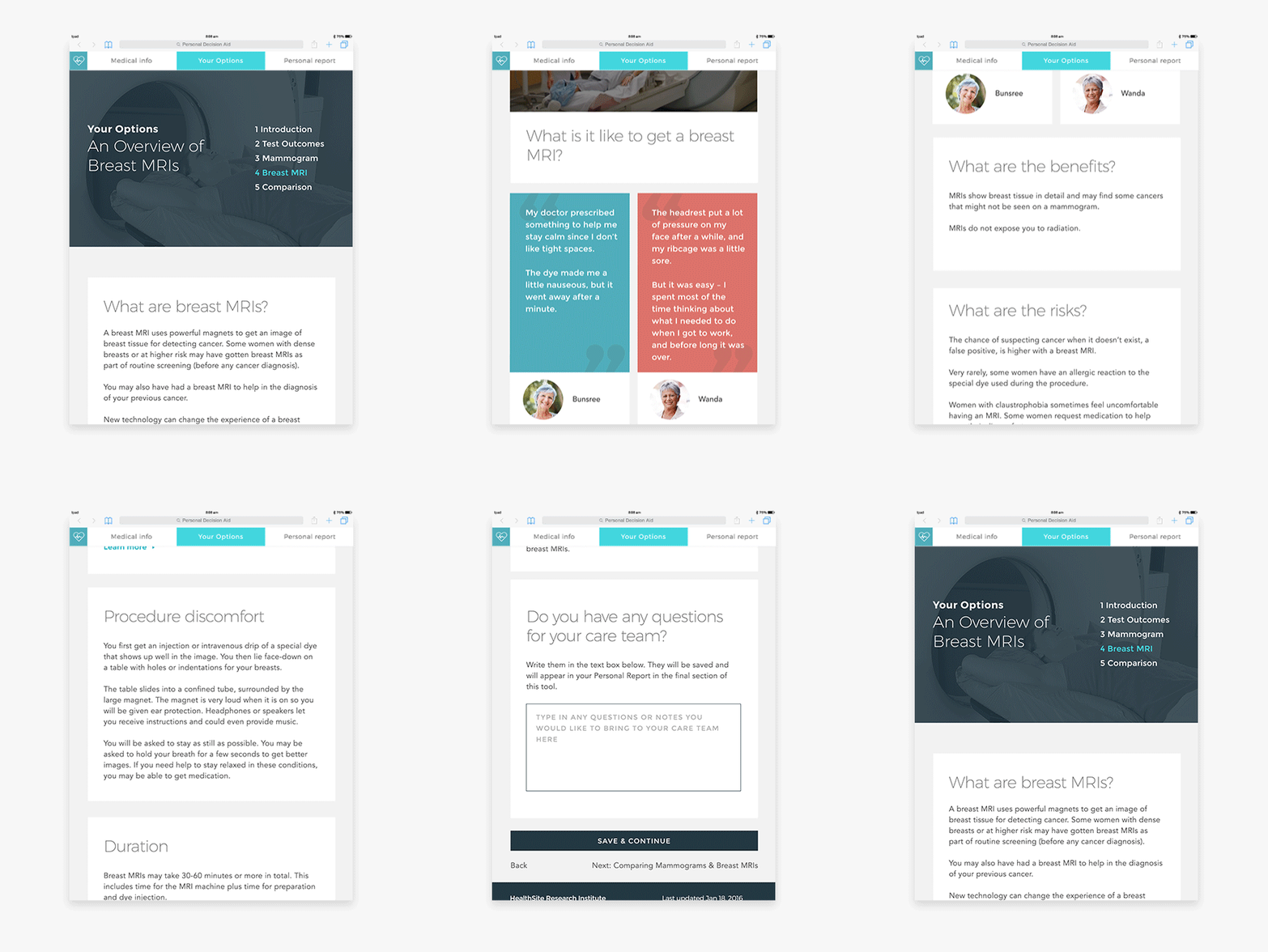
Values clarification: guided prompts helping patients identify what they’re optimizing for before seeing options
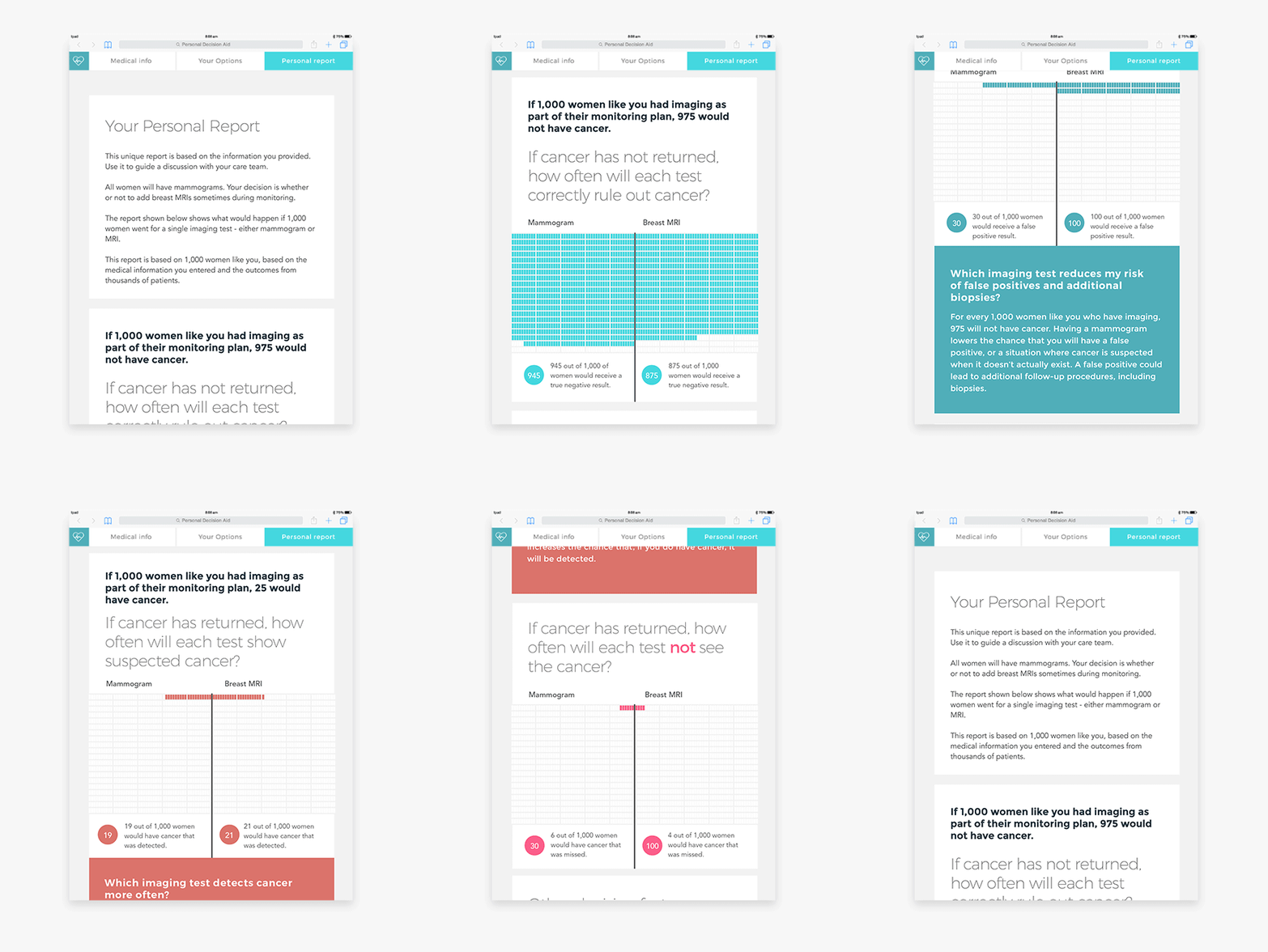
Personalized risk report: numerical, text, and pictograph formats calibrated to minimize cognitive bias
Screenshots available at artefactgroup.com/case-studies/simba-decision-aid/
The finished tool generated a personalized report based on each patient’s medical history and GHRI’s effectiveness data — presenting risk information in numerical, text, and pictograph form, with visualizations designed to surface tradeoffs rather than steer toward an answer. Guided value-reflection prompts helped patients articulate what they were actually optimizing for: fear of missed detection, tolerance for false alarms, cost sensitivity, how they weighed convenience against thoroughness.
The tool was designed to be used before a clinical appointment — mobile-optimized, printable, and emailable — so patients arrived at physician conversations with a clear picture of their own priorities. That shift changed the nature of the conversation: less explaining-from-scratch, more shared deliberation. Patients came prepared. Clinicians had a shared framework to work from.
Human-centered design turned the insights from our research into a tool that can help breast cancer patients feel confident and comfortable with their decisions in a time of high anxiety. — Karen Wernli, Group Health Research Institute
Breast cancer survivors facing this decision annually — with almost no structured guidance available before SIMBA.
Patient confidence and preparation: clearer priorities, better questions, more productive physician conversations.
Anxiety in a population already managing fear of recurrence — addressed through sequencing, plain language, and bias-reducing visualizations.
A proof point that human-centered design can make a measurable difference in high-stakes clinical decision-making — not just satisfaction, but quality of choice.